
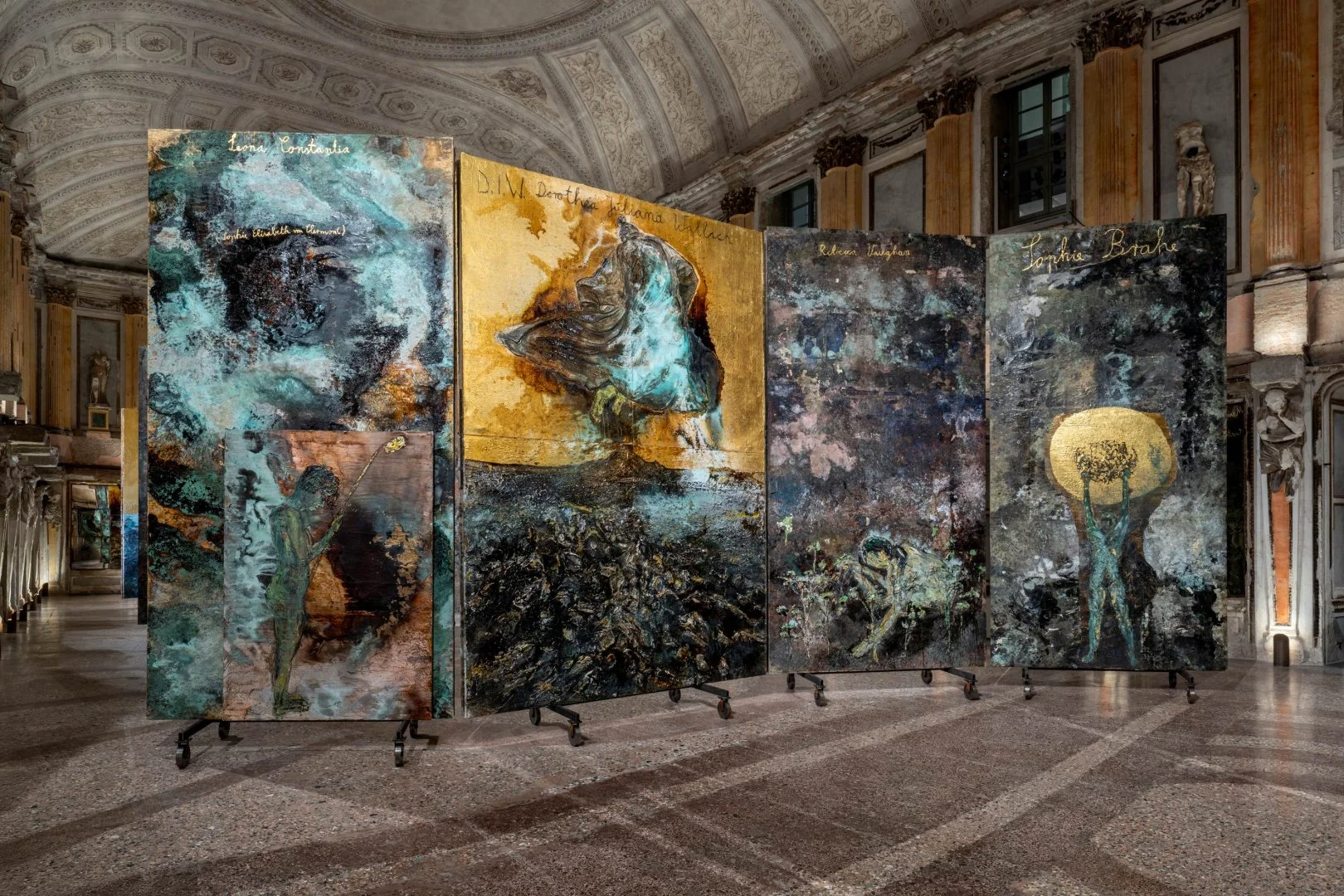
Anselm Kiefer. Le Alchimiste, 2026. Milano, Palazzo Reale, Sala delle Cariatidi. Installation view. Photo: ©ElaBialkowska, OKNO Studio. Courtesy of Palazzo Reale
Le Alchimiste. Anselm Kiefer
February 7th - September 27th, 2026
Palazzo Reale
Piazza del Duomo, 12. Milan. Italy
Anselm Kiefer presents Le Alchimiste at the Palazzo Reale in Milan. A tribute to the women who, in their day, took an interest in alchemy and whose work, although persecuted and hidden in their time, was essential to the birth of modern scientific thought. The exhibition project, consisting of 38 large-format canvases, is specially designed for the Sala delle Cariatidi in the Milanese palace.
The artist weaves a dialogue with the architecture of the space that houses his proposal: the Sala delle Cariatide, where the fire caused by the Allied bombing in 1943 almost destroyed all forty sculptures of the women of Caria or the Caryatids, which support the perimeter balcony of the room. Thus, Kiefer not only reveals the intellectual universe of alchemists, but also reflects on history, painting, and female memory.
Kiefer offers us an initiatory journey through his creations. The texture of his painting reveals an alchemical language, thanks to which each of his canvases brings to light both a female face and its oblivion within the official history constructed over centuries. Le Alchimiste is thus in line with the notions revisited by the artist over decades: myth, history, collective memory, identity, destruction, and regeneration.
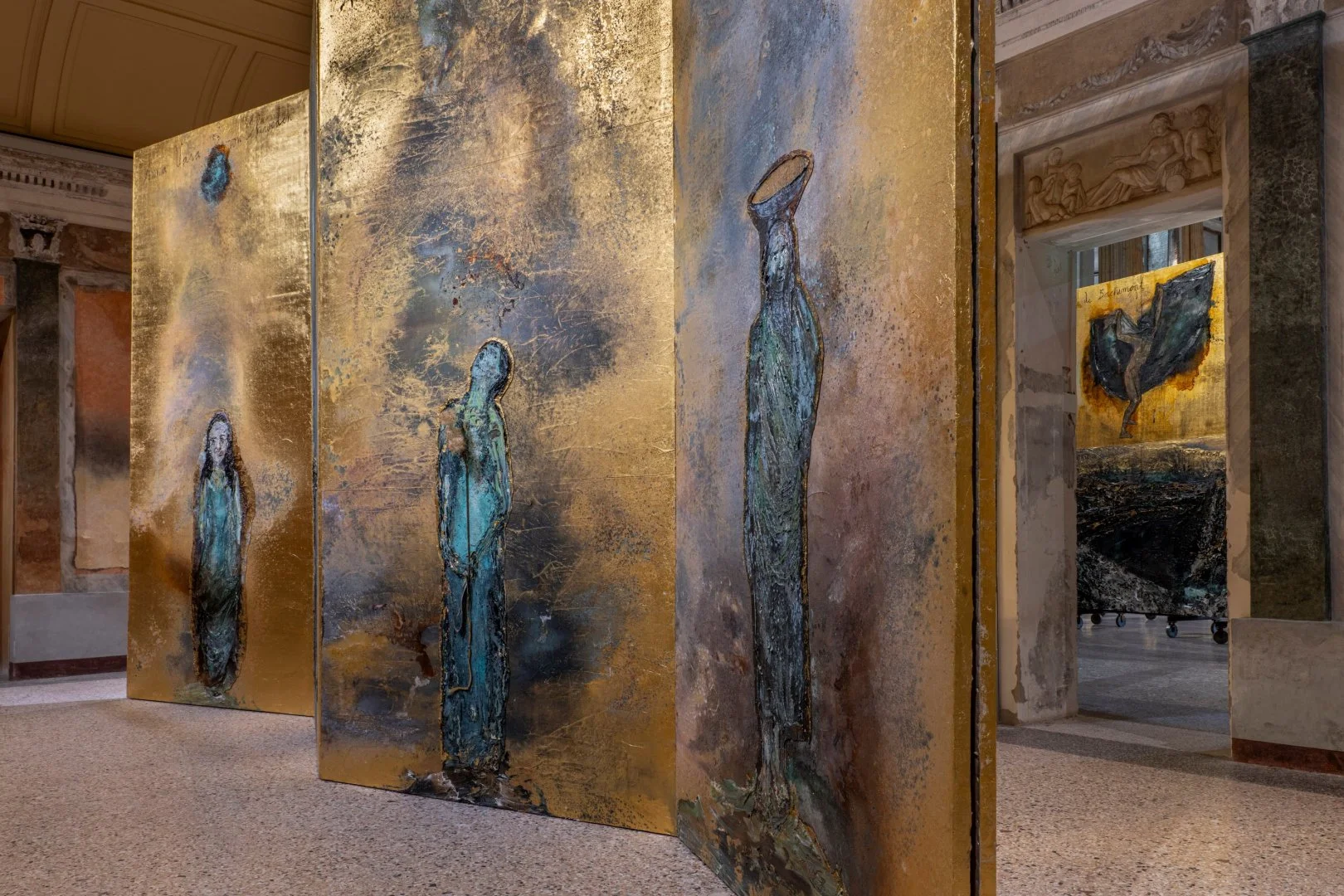
Anselm Kiefer. Le Alchimiste, 2026. Milano, Palazzo Reale, Sala del Piccolo Lucernario. Installation view. Photo: ©ElaBialkowska, OKNO Studio. Courtesy of Palazzo Reale
Kiefer interprets the alchemical motto Obscurum per obscurius, ignotum per ignotius (“the obscure through the more obscure, the unknown through the even more unknown”). His pictorial approach, which includes the use of electrolysis and fire, is in itself both a symbolic event and a narrative tool. The latter allows him to transcend the mere act of historical recovery in order to give corporeality to female alchemists: an emerging identity, a history, a transfigured matter, and inaugurating the vision of a new female pantheon.
The spectral figures that the artist brings to life in the Sala delle Cariatidi, suspended between myth, science, magic, and philosophy, speak of exclusion, condemnation, and abjuration. Nevertheless, they also tell of experiments and discoveries, medical remedies and beauty treatments, distillation processes, and remedies for both the body and the mind.
Kiefer tells us about Caterina Sforza, daughter of Galeazzo Maria Sforza, Duke of Milan, where she spent her youth. She was a scientist, condottiera, and author of a rare manuscript containing more than 450 recipes for medicines, cosmetics, and alchemical formulas. He also tells us about Isabella Cortese, who is credited with writing one of the most famous books of secrets of the Renaissance. And of Christina of Sweden, daughter of Gustav II Adolph Vasa and Maria Eleonora of Brandenburg, who turned Stockholm into a center of European patronage. Also of Margaret Cavendish, one of the few female philosophers of the 17th century, author of works that intertwined metaphysics, poetry, and science. And Mary Anne Atwood, a key figure in the spiritual reception of alchemy in 19th-century England. Or Marie Meurdrac, a self-taught chemist and pioneer of women's scientific dissemination. Anne Marie Ziegler, court alchemist in reformed Germany, condemned to the stake in 1575 for her theories considered perverse and arrogant. In addition to Sophie Brahe, a bridge between court culture and the laboratory.
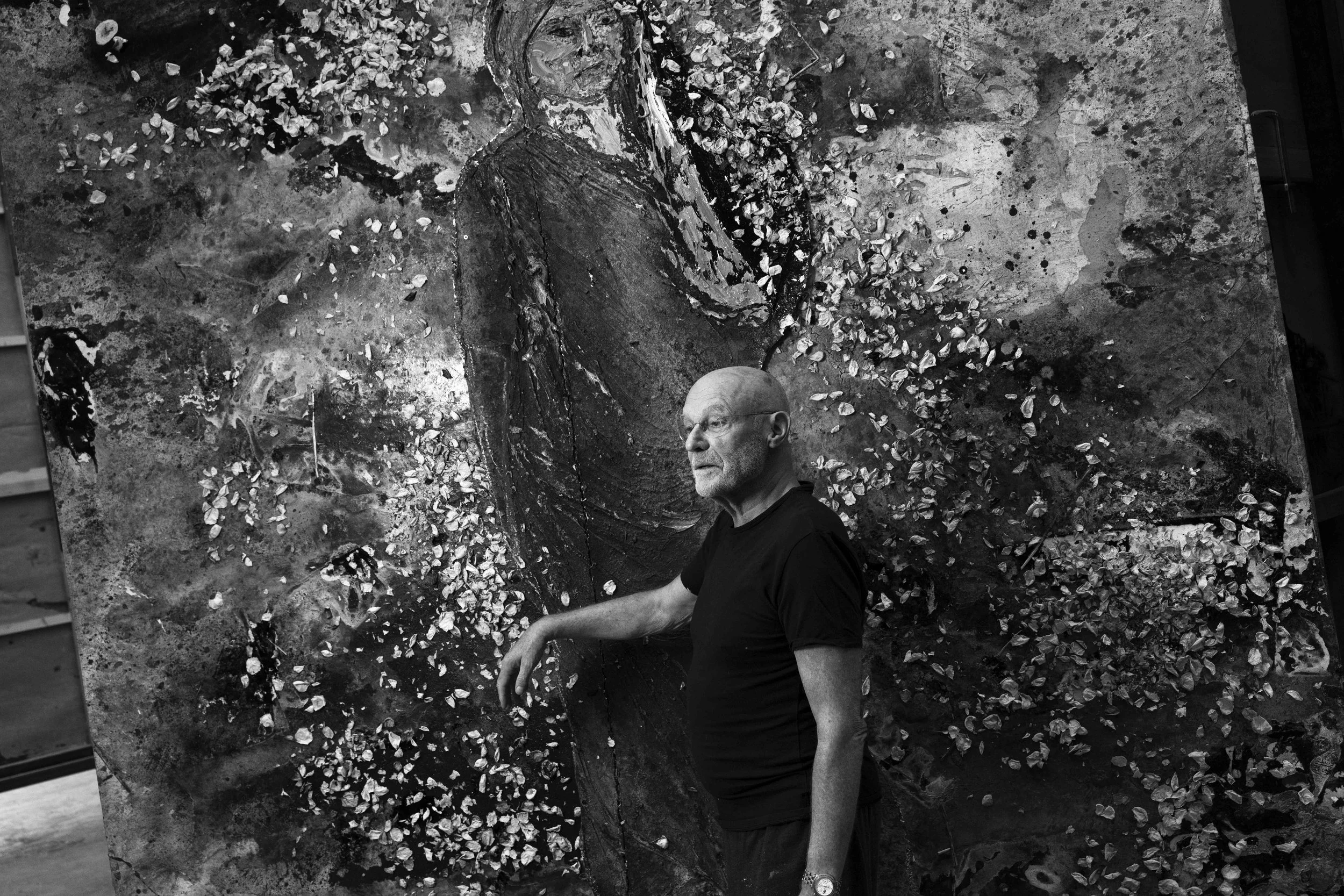
Anselm Kiefer © Paolo Pellegrin. Courtesy of Palazzo Reale
Women who, thanks to their talent and rigor, found answers in nature and turned their attention to healing the body and spirit, dedicating themselves to practical and experimental knowledge in an era prior to modern science. They are now summoned by Kiefer as a representation of the creative and redemptive powers of women throughout history.
Le Alchimiste by Anselm Kiefer is curated by art historian Gabriella Belli. It is also promoted by the Culture Department of the City of Milan and produced by Palazzo Reale and Marsilio Arte, with the collaboration of Gagosian and Galleria Lia Rumma. The exhibition is part of the Milan Cortina 2026 Cultural Olympiad, the multidisciplinary, pluralistic, and widespread program that encourages Italy to promote Olympic values through culture, heritage, and sport, on the occasion of the Milan Cortina 2026 Winter Olympic and Paralympic Games.